Fortnite Fight Entries: Join With Information, Support and a Return Route
A distant exchange can offer an opening or conceal several threats. Before joining, compare what your squad knows, how it will arrive and what protection is available under the current ruleset.
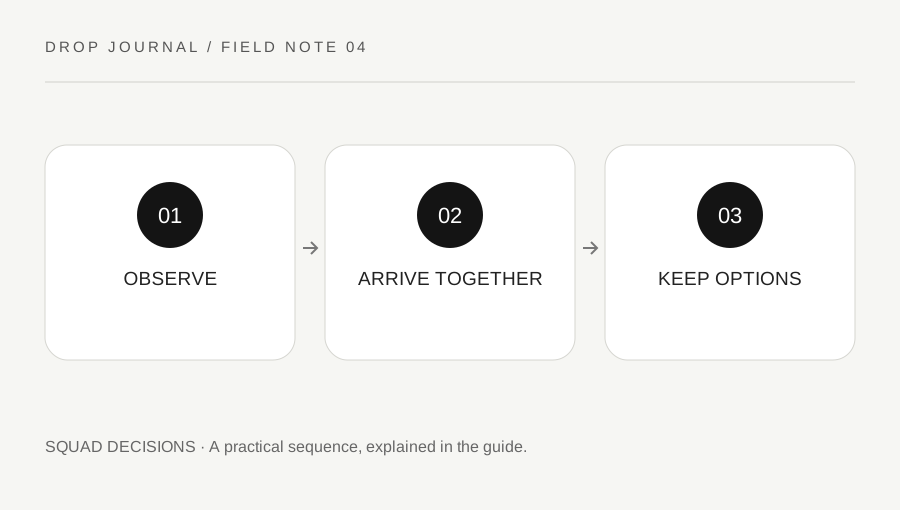
Original explanatory diagram. Examples illustrate a method or decision; they are not claims of personal testing.
Treat sound and damage as incomplete evidence
Gunfire indicates activity without revealing every opponent or their condition. A visible damage opportunity does not establish that the target is isolated. Check the surrounding terrain, structures and squad locations before turning the observation into a push.
State uncertainty in the call: fight location approximate, numbers unknown or another angle not checked. This gives teammates information they can use rather than a promise of an easy finish. A player who sees a target clearly may still lack the view needed to judge the whole encounter.
Read the actual playlist. Building-enabled and Zero Build entries use different protection options, and creator experiences can change rules further. Do not assume a recovery, mobility or construction option exists merely because it was available in the last session.
Trace the arrival position
Identify cover at the destination and the angles crossed to reach it. A direct route can arrive quickly but expose the squad before anyone can support the first player. A slower route can preserve protection while losing the original opening. Name the tradeoff instead of treating speed as the only objective.
Check teammate readiness. Someone recovering, selecting equipment or moving from another position may not be able to follow immediately. An entry is coordinated when the squad can apply useful pressure together, not just when all players are heading roughly toward the same sound.
For a worked example, a duo sees two opponents exchanging fire near a structure. One player begins to cross open ground while the other remains behind a hill. They pause to create a shared approach and identify the next protection before committing, rather than converting the early sighting into a separated arrival.
Connect utility or building to a specific action
If the ruleset allows construction, decide which angle a piece should affect and what movement follows. In a no-build context, inspect existing cover and the supported equipment available. An effect is useful when it changes a relevant part of the approach, not merely because it creates visual activity.
Agree on a simple stopping condition, such as a new opponent angle or loss of the return route. If the situation changes, update the plan. A call to push does not require continuing through information that makes the original approach unsuitable.
Avoid chasing a damaged player beyond the squad's support without inspecting the new position. The target's health is only one variable. A retreating opponent can lead toward cover or teammates, and an exposed chase can surrender the advantage the original observation provided.
Review the reset after the exchange
Once pressure ends, inspect squad condition, nearby threats and the route onward before focusing on rewards. Another team can respond to the same sound that attracted you. Keep the storm situation and next movement in view without assuming a successful elimination ends the decision chain.
Review the entry with one question: did the squad arrive in a position that preserved useful options? A win can still contain an unsupported crossing, while a lost exchange can reveal a reasonable choice followed by a mechanical mistake.
Finish with one concrete correction, such as confirming readiness before leaving the ridge or choosing a shared fallback. This turns fight entry into a repeatable observation process. It does not remove uncertainty, but it prevents a partial glimpse from being treated as complete knowledge about an encounter your squad has not yet reached.
A practical checklist
Choices are saved in this browser. Reset them here or clear this site’s browser storage.
Questions that come up
Does damage mean an opponent is safe to chase?
No. Check the new position and supporting angles. Health information does not reveal every nearby threat.
Is the fastest route always the best entry?
No. Arrival cover, exposure and teammate support matter alongside timing.
Must a called push continue after new information?
No. Update the plan when the situation changes. Holding or leaving can be the useful response.
References & scope
Background references checked on 18 October 2026. Worked examples and diagrams are original teaching material.