Review a Fortnite Encounter: Separate Information, Construction and Aim
A short review can locate a repeatable mistake without turning one elimination into a judgment of every skill. Begin before the final exchange and keep the current ruleset in the analysis.
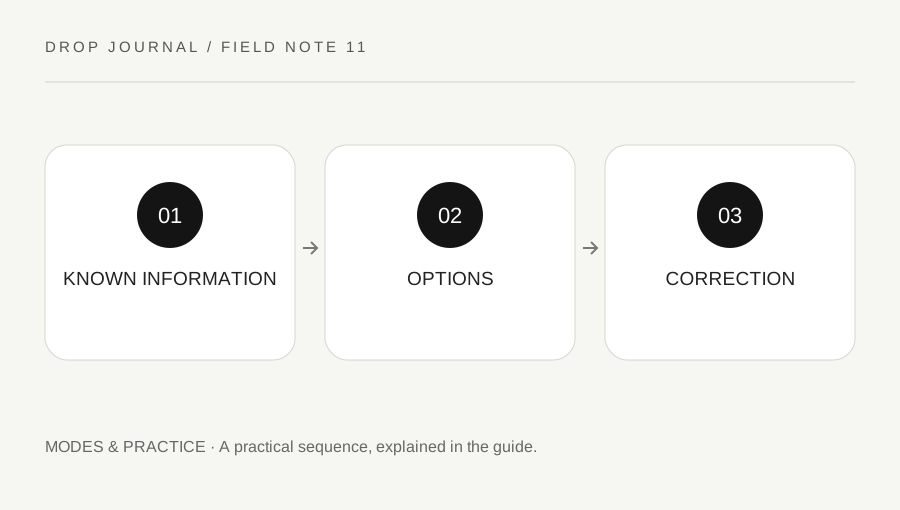
Original explanatory diagram. Examples illustrate a method or decision; they are not claims of personal testing.
Choose a short question and available evidence
Use a recording, a supported replay if available on your setup, or an honest reconstruction of one encounter. This page does not guarantee replay support for every platform or mode. If the evidence is incomplete, keep the missing part visible.
Choose a question such as why you crossed a lane, why the edit exposed you or why a partner could not follow. “Why did I lose?” is too broad for a useful first review. Start a little before the commitment rather than watching only the final missed shot repeatedly.
Write what you knew then and what you learned afterward. An opponent visible only in a later camera view should not be treated as information you possessed during the match. This distinction keeps the analysis grounded in the decision rather than hindsight.
Map the options under the actual mode rules
Identify current cover, reachable protection, squad position and storm requirements. In a building-enabled match, include the resources and supported pieces actually available. In Zero Build, inspect the terrain and current kit instead of proposing a construction solution the mode does not allow.
List only realistic alternatives. A route through an unseen enemy position or a mobility option absent from the inventory is not a fair comparison. The review should improve practical choices, not invent a perfect route after seeing the entire outcome.
For a worked example, a player blames aim after being eliminated during a crossing. The review shows that they left cover before the partner arrived and had no next protection. The first correction concerns the crossing decision; mechanical practice may still help, but it does not explain every part of the failure.
Separate the source of the error
Use headings for information, positioning, building or utility, and execution. Under each, write a specific event rather than a general label. “Reset did not close the opening” is different from “opened the wrong angle,” even though both involve editing.
If technical stutter or input trouble appears in the evidence, record it separately. Do not assume every awkward camera movement reflects a tactical decision, but do not invoke an invisible technical problem without evidence either.
Review successful encounters as well. A risky action can work because an opponent misses, and a well-supported choice can still lose an exchange. Outcome alone is an incomplete training signal. Ask whether the action made sense from the known information and whether its execution matched the intention.
Make one next-session experiment
Choose a small correction connected to the evidence: inspect the next cover before crossing, confirm the edit state before moving or announce when a teammate loses the angle. Keep the action simple enough to notice during normal play.
After a few relevant situations, record whether the check occurred and what it revealed. Do not claim that two wins prove a permanent improvement. A useful result can be recognizing a poor route early and choosing a different action.
Finish with three lines: observation, likely cause and next test. Preserve uncertainty when the evidence cannot settle the cause. This method creates a manageable learning loop without demanding a long match analysis, and it prevents every difficult encounter from triggering unrelated changes to sensitivity, mode or equipment before the actual problem has been identified.
A practical checklist
Choices are saved in this browser. Reset them here or clear this site’s browser storage.
Questions that come up
Does a replay always show exactly what I knew?
No. A later or different camera view can reveal information unavailable during play. Keep that distinction in the review.
Should every loss lead to a new sensitivity?
No. First locate the cause. Positioning, building state, coordination or technical issues may explain the encounter.
Can a win hide a mistake?
Yes. Judge the decision and execution as well as the result. An opponent’s error can rescue an unsupported action.
References & scope
Background references checked on 18 October 2026. Worked examples and diagrams are original teaching material.