Fortnite Building Practice: Place One Useful Protective Piece
A building action should change a specific angle. Begin with one intended wall or ramp in a supported practice environment, then connect placement, movement and weapon readiness.
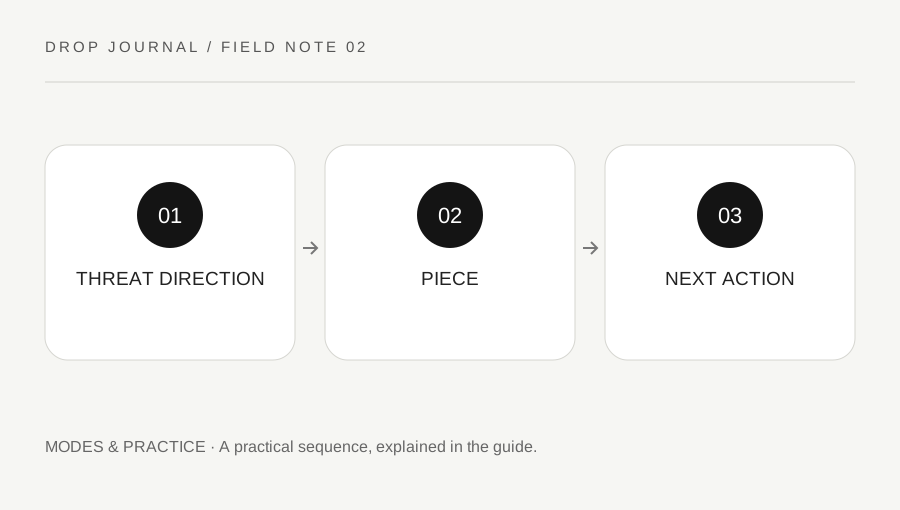
Original explanatory diagram. Examples illustrate a method or decision; they are not claims of personal testing.
Choose an environment that permits the task
Confirm that building is enabled and that the practice environment supplies the conditions needed for ordinary construction. Creator islands can use their own rules, so a drill that works in one may not represent the resource limits or restrictions of a Battle Royale match.
Use the current control settings to identify build selection, placement and return-to-weapon actions on your device. Do not copy another platform's button sequence without checking the actual binding. Save your baseline if you change a control for the exercise.
The initial task is placing one chosen piece in one chosen location. It is not a speed-building routine or an exploit tutorial. A slow correct action that serves a visible purpose gives you a foundation for more complex movement later, while random rapid placement can hide uncertainty about what each piece is meant to do.
Name the angle the piece should affect
Stand in a simple practice position and identify an imagined threat direction. Choose where a wall would block that line or where a ramp would support a deliberate change in elevation. Inspect the preview and intended orientation before confirming placement.
After placing it, move slightly and check what remains exposed. One piece does not protect every side, and stepping beyond its edge can reopen the original angle. State the limitation rather than treating the appearance of construction as complete safety.
For a worked example, a player wants to interrupt one forward sightline before moving to nearby cover. They place a wall facing that direction, confirm the next route and return to their weapon. The useful result is a supported transition, not the number of pieces placed in the shortest time.
Connect placement with the next control
Practice the sequence slowly: select the piece, place it intentionally, return to the intended weapon and identify the next cover or angle. If the wrong item appears, stop and inspect the binding or selection state rather than repeating the motion faster.
Keep the camera stable enough to understand orientation. A hurried turn can produce a correct piece in an unhelpful place. Record whether the problem is selection, placement direction or the transition back to the weapon. Those are different errors and should not receive the same correction.
Add movement only after the stationary sequence is understandable. A small step or short crossing is enough initially. Keep the exercise within supported mechanics and avoid macros that automate the sequence; they change the skill being practiced and can violate the game's rules.
Add realistic constraints gradually
Once the sequence is reliable, practice with a limited resource amount or mild pressure in a suitable environment. Check how quickly the task consumes the available material and whether the piece still supports the intended movement. Do not assume unlimited-resource practice teaches every match decision.
Review one attempt using the original purpose: did the piece affect the intended angle, and was the next action ready? A wall that appears in the right place but leaves you confused in build mode reveals a transition problem. A clean transition beside an incorrectly oriented wall reveals a placement problem.
Finish by choosing one correction for the next set. A useful first building habit is intentional protection linked to movement and readiness. More elaborate structures can come later, but they should preserve that connection rather than turning construction into a separate performance unrelated to the threat or destination.
A practical checklist
Choices are saved in this browser. Reset them here or clear this site’s browser storage.
Questions that come up
Does placing a wall make every side safe?
No. Check the angles it actually blocks and the exposure created when you move beyond it.
Should I practice with unlimited materials only?
It can isolate controls, but later add realistic resource constraints. Unlimited practice does not teach every match decision.
Can a macro replace the control sequence?
Use ordinary supported controls. Automation changes the practice task and can conflict with the game’s rules.
References & scope
Background references checked on 18 October 2026. Worked examples and diagrams are original teaching material.